
With Halloween soon upon us, comical images of vultures on gravestones and in trees can easily be found on merchandise and online. These images tend to exaggerate the looks of vultures, which are already a bit unusual looking as far as birds go – one might say they have a face that only a mother could love. Rather than making fun of how they look, we should consider them to be superheroes of the environment.
We have two species of vultures in our area:the turkey vulture and the black vulture. Like vultures around the world, both have bare skin on their faces and upper necks, an adaptation that helps them stay clean while feeding. You can often spot them gliding gracefully on warm air currents. Black vultures soar higher, their wings held flat, while turkey vultures fly lower, forming a slight V shape in flight. With wingspans of up to six feet for turkey vultures and about four and a half feet for black vultures, these birds are remarkably elegant in the air. And if you ever notice a group circling above, it usually means there’s carrion on the ground below.
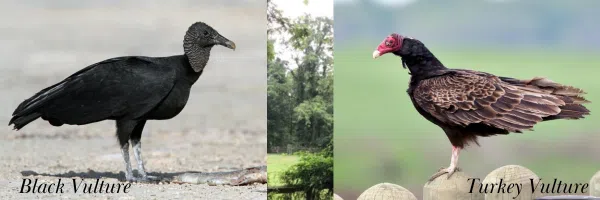
Our vultures earn their superhero status by eating roadkill and other dead animals, though black vultures may occasionally prey on small mammals and unprotected young birds (according to the National Geographic Society). Turkey vultures find carrion by scent, while black vultures find it by sight. Black vultures are smaller than turkey vultures, but are more gregarious and will push turkey vultures off prey. By eating carrion, the vultures prevent the spread of diseases. Their bald heads are important for this very reason, and if you ever see a vulture sitting in the sun with its wings spread out, they are using the sun to kill pathogens on their bodies. Vultures also help prevent climate change. When a body dies, carbon-based gases form inside as part of decomposition. If these gases were released, they would add greenhouse gases to the atmosphere. Vultures prevent this from happening.
Local vultures are not endangered but do face issues. Habitat loss can limit nesting places and food. Both types of vultures use tree hollows for their nests as well as hollow logs, caves and even abandoned buildings according to the Audubon Society. If we lose habitat for various animals, vultures lose their food source. Poisoning is also a risk if it was used to kill whatever they are eating.
Fossil evidence shows vultures have been around for roughly 100,000 years. So, while they may be unusual looking, we should be grateful for the role they play and the service they provide our environment and love them like a mother.
Stay curious, stay kind, and maybe thank a vulture this week,